

At a glance
- Aligners are removable and hard to notice, but they only work when worn for most of the day and night.
- Not every bite problem suits aligners. Some tooth movements are more reliable with fixed braces.
- Treatment time depends on how much movement is needed. Your orthodontist estimates it after an assessment.
- Retainers after treatment are essential. Without them, teeth tend to drift back.
- FaceLab offers Invisalign and Graphy Clear Plus aligners. Your orthodontist recommends the system after examining you.
Who are clear aligners for?
Aligners can treat many of the common reasons people want straighter teeth. They are often chosen by adults who do not want visible braces, and by people whose teeth have moved again after earlier orthodontic treatment.
- Crowded or overlapping teeth
- Gaps between teeth
- Teeth that have moved after earlier braces
- Some bite problems, such as a mild overbite, underbite or crossbite
When braces or other treatment may be better
Aligners are one tool among several. Some movements, such as large rotations, pulling a tooth down into line or closing big spaces, can be harder to control with aligners alone. Where the upper and lower jaws do not match in size or position, moving teeth may not be enough, and jaw surgery combined with orthodontics may be discussed.
Tooth decay and gum disease need to be treated before any orthodontic treatment starts. Your orthodontist will explain the options that apply to you, including fixed braces, and the reasons for the recommendation.
Your assessment and plan
Your orthodontist examines your teeth, gums and bite, and takes photographs and X-rays. A digital scan of your teeth can replace conventional impressions, and a three-dimensional simulation of the planned tooth movement is available so you can see the intended result before you begin.
The simulation is a plan, not a promise. Teeth do not always follow the plan exactly, which is why treatment is reviewed and adjusted along the way.
Living with aligners
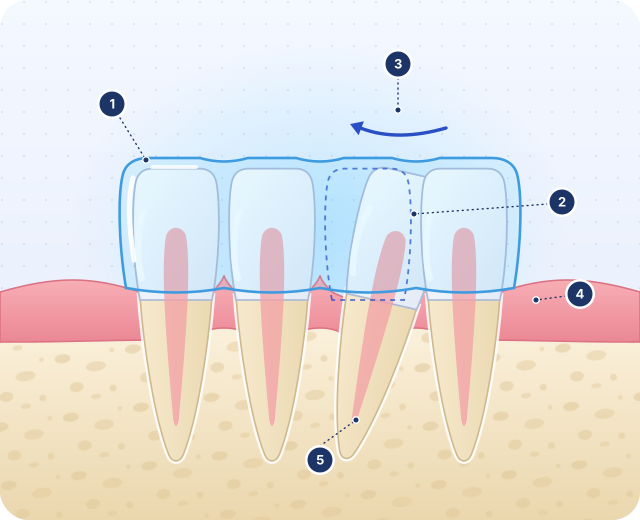
Each set of aligners moves the teeth a small amount. You change to the next set as instructed by your orthodontist, often every one to two weeks. Reviews are commonly every six to eight weeks, and some monitoring can be done remotely.
- Wear your aligners as advised, usually 20 to 22 hours a day. Take them out only to eat, drink anything other than water, and clean your teeth.
- Brush before putting aligners back in, so food and sugar are not held against the teeth.
- Small tooth-coloured attachments may be bonded to some teeth to help the aligners grip.
- Sometimes a little enamel is polished away between teeth to create space. Your orthodontist will tell you if this is planned.
- Keep your previous set until you are settled in the next one, in case an aligner is lost or broken.
Aligner systems at FaceLab
FaceLab offers two kinds of aligner. Invisalign aligners are formed from plastic sheets over a series of models, an approach that has been used for many years. Graphy Clear Plus aligners are printed directly in a shape memory material.
Each system has strengths, and the choice depends on the movements your teeth need. Your orthodontist will recommend one after examining you and will explain why.
Retainers
Teeth have a lifelong tendency to move. When active treatment ends you will be given retainers, which may be removable, fixed behind the teeth, or both. Wearing them as advised is the most important thing you can do to keep your result. Retainers wear out and need replacing from time to time.
Possible risks and limits
Aligner treatment is generally well tolerated, but it has risks and limits like any orthodontic treatment. Your orthodontist will discuss the ones that apply to you.
- Pressure or tenderness for a few days with each new set, and a slight lisp while you get used to them
- Tooth decay or gum inflammation if teeth and aligners are not kept clean
- Teeth that do not follow the plan, which may need extra aligners or a change to fixed braces
- Slight shortening of the tooth roots, a recognised effect of moving teeth that is usually minor
- Small dark spaces near the gum between teeth that were crowded, more often in adults
- Teeth drifting back if retainers are not worn
If you live abroad
FaceLab offers an aligner arrangement for patients who live overseas, with an initial visit for records and fitting, followed by remote monitoring. Whether this is suitable depends on your teeth, and some problems can only be dealt with in person. Your orthodontist will advise after an assessment.
Why have aligner treatment at FaceLab
Treatment is planned and supervised by consultant orthodontists, who provide both aligners and fixed braces and so can recommend whichever suits you. Digital scanning and treatment simulation are available. If your bite needs more than orthodontics, maxillofacial surgeons work in the same clinic at The Shoppes at City of Dreams, Colombo.
Clear aligners: common questions
Most people feel pressure or tenderness for a few days when they start a new set. This usually settles and can be managed with simple pain relief if needed. Tell your orthodontist if an aligner rubs or if pain does not settle.
It depends on how much tooth movement is needed. Small corrections can take a few months, while more complex treatment can take a year or two. Your orthodontist will give you an estimate after your assessment, and it can change during treatment.
Neither is better for everyone. Aligners are removable and less visible. Fixed braces work all the time and give more control over some movements. The right choice depends on your teeth and on how reliably you will wear aligners.
Take them out to eat and to drink anything other than plain water. Hot drinks can distort the plastic, and sugary or coloured drinks can cause decay and staining under the aligner.
There is no upper age limit. Teeth can be moved at any age if the teeth and gums are healthy. Your orthodontist will check this first.
Starting prices for Clear Plus and Invisalign aligners are published on our fees page. Your own fee depends on how complex your treatment is and is confirmed in writing after your assessment.
Consultant-led care, with 3D imaging available
Talk to our team about your case
General information, not a diagnosis. Your consultant will advise on your own treatment. Last reviewed 2026-11-16.