

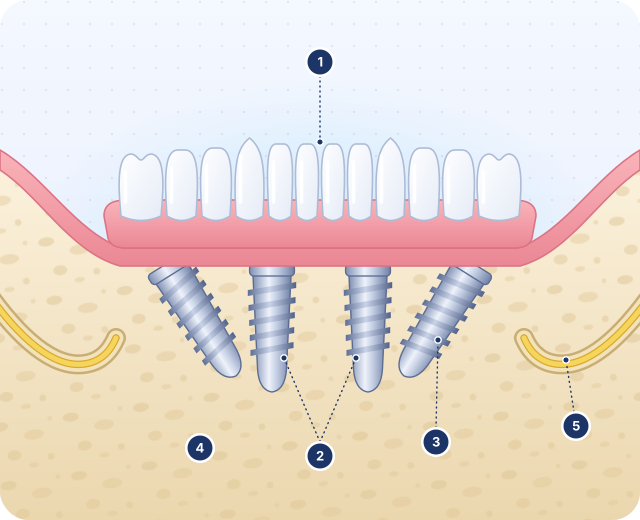
At a glance
- A full arch of teeth can be supported by a small number of implants, commonly four to six.
- Options range from a removable denture held by implants to a bridge that is fixed in place.
- In suitable cases temporary fixed teeth can be fitted at the time of surgery. The final teeth are made after healing.
- Where upper jaw bone has been lost, bone grafting or zygomatic implants may be discussed.
- Implant teeth need daily cleaning and regular maintenance for life.
Who is this treatment for?
Full mouth implant treatment may be considered if you have lost all the teeth in one or both jaws, if your remaining teeth are failing because of advanced gum disease or decay, or if you cannot manage with conventional dentures.
It is a major course of treatment. A conventional denture remains a reasonable choice for many people, and your specialist should discuss it with you alongside the implant options.
The main options
The right option depends on your bone, your health, how you want to clean your teeth, and cost.
- Implant-retained denture. A removable denture that clips onto a few implants. It is steadier than a conventional denture and is taken out for cleaning.
- Fixed full-arch bridge on four or six implants, often called All-on-4 or All-on-6. The teeth stay in and are removed only by the dental team.
- Zygomatic implants. Longer implants anchored in the cheekbone, used for some patients with severe bone loss in the upper jaw.
Your assessment and plan
Planning starts with your medical history, an examination, photographs and a 3D cone beam CT (CBCT) scan to measure the bone. Conditions such as diabetes need to be well controlled, and you will be advised to stop smoking.
The position of the implants and the shape of the new teeth are planned together. Digitally guided surgery with custom 3D-printed guides is available where your case calls for it. You should receive a written plan that explains the stages, the alternatives and the fee.
The stages of treatment
The exact sequence varies from patient to patient. A common pattern is described below.
- Surgery. Any failing teeth are removed and the implants are placed, under local anaesthetic with sedation or under general anaesthesia.
- Temporary teeth. Where the implants are firm enough, a temporary fixed bridge is fitted at the time of surgery or soon after. If not, a denture is worn while the implants heal.
- Healing. The bone bonds to the implants over several months. A soft diet is usually advised during this time.
- Final teeth. Once healing is confirmed, the final bridge or denture is made and fitted.
- Maintenance. Regular reviews and professional cleaning.
If you are travelling for treatment
Full-arch treatment is usually staged over two visits. FaceLab's All-on-4 package, for example, plans an initial stay of 7 to 10 days, with a return visit after about 4 to 6 months for the final teeth. Your specialist confirms the timing for you after a consultation, and it may change as your healing requires.
Recovery and long-term care
Swelling, bruising and discomfort are expected for the first week or so and are managed with medicines and aftercare advice. New teeth can feel bulky at first, and speech usually adapts over a few weeks.
Implant teeth do not decay, but the gums and bone around the implants can become inflamed and infected if they are not cleaned well. You will be shown how to clean under and around the bridge every day. Regular check-ups matter as much as they do for natural teeth.
Possible risks
This is a surgical treatment and carries risks. Your specialist will explain how they apply to you before you decide.
- Infection, bleeding, swelling and bruising after surgery
- One or more implants failing to bond with the bone, which may mean further surgery or a change of plan
- Altered feeling in the lip, chin or tongue after lower jaw surgery, which is usually temporary but can be lasting
- Sinus problems after upper jaw or zygomatic implants
- Fracture or wear of the temporary or final teeth, which may need repair
- Inflammation and bone loss around implants in later years, more likely with smoking, poor cleaning or a history of gum disease
- The risks of sedation or general anaesthesia, which the anaesthetic team discusses with you
Why have this treatment at FaceLab
Implant placement at FaceLab is led by maxillofacial specialists, working with restorative specialists who design and fit the teeth. The team can manage zygomatic and bone-grafting cases. Imaging, planning, surgery and follow-up are in one clinic at The Shoppes at City of Dreams, Colombo.
FaceLab implant packages carry a warranty, with conditions that include good oral hygiene and annual check-ups. The terms are set out on the treatment packages page.
Full mouth dental implants: common questions
It describes a full arch of fixed teeth supported by four implants. Some patients are advised to have more than four, depending on their bone and bite. Your specialist recommends the number after assessing you.
In suitable cases, yes: a temporary fixed bridge can be fitted at the time of surgery or shortly after. It depends on how firmly the implants hold in your bone. If they are not firm enough, a denture is worn during healing instead.
The plan normally aims to avoid this, using either a temporary fixed bridge or a denture during healing. Ask your specialist what is planned for you.
Not for everyone. A fixed bridge feels more like natural teeth. A removable denture is easier to clean, can give more support to the lips, and usually needs fewer implants. Your specialist will explain which suits your mouth.
There is no upper age limit. Suitability depends on your general health and bone. Where bone is thin, grafting or zygomatic implants may be options. This is assessed with a 3D scan.
The fee depends on the option chosen, the number of implants and the type of teeth. You receive it in writing after your assessment. Our fees page shows the starting price of a single implant with crown and the full fee schedule.
Consultant-led care, with 3D imaging available
Talk to our team about your case
Related
General information, not a diagnosis. Your consultant will advise on your own treatment. Last reviewed 2026-11-16.