

At a glance
- For bite and facial problems caused by the position of the jaws: underbite, overbite, open bite, crossbite and asymmetry.
- Usually done once growth has finished, in late teens or adulthood.
- Treatment typically combines braces or aligners before and after surgery with the operation itself.
- The surgery is done under general anaesthesia, mostly from inside the mouth.
- Planned by a team of surgeon and orthodontist; 3D scans and virtual surgical planning are available.
Who is jaw surgery for?
Some bite problems cannot be corrected with braces or aligners alone, because the upper or lower jaw itself is too far forward, too far back, too long, too short or not symmetrical. Jaw surgery may be recommended when this causes:
- Difficulty biting or chewing, or teeth that do not meet properly (open bite)
- A prominent lower jaw (underbite) or a retruded lower jaw and chin (overbite)
- A crossbite or a jaw that is visibly to one side (facial asymmetry)
- Jaw joint strain, uneven wear of the teeth or problems with lip closure
- In selected cases, narrowing of the airway contributing to obstructive sleep apnoea
How treatment is planned
Treatment begins with a joint assessment by the maxillofacial surgeon and the orthodontist: photographs and X-rays, and where needed a 3D scan of the face and jaws and digital scans of the teeth.
Where virtual surgical planning is used, the team moves the jaws on a 3D model of your own anatomy to work out a suitable position for your bite and face. The planned change can be shown to you before surgery, and the plan can be transferred to the operation with custom guides and splints.
The stages of treatment
Most patients go through three stages. Your team will explain the timeline for your case.
- Orthodontics before surgery: braces or aligners line up the teeth on each jaw so they will fit together once the jaws are moved
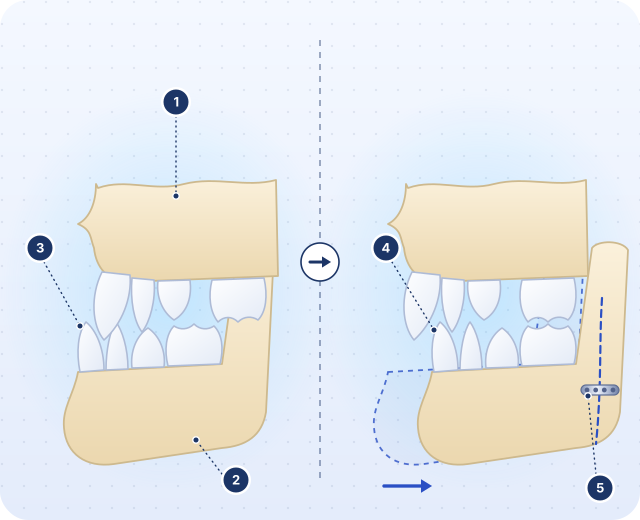
- Surgery: the jaw bones are repositioned and held with small titanium plates and screws
- Orthodontics after surgery: a shorter phase to fine-tune the bite, followed by retainers
The operation and hospital stay
Jaw surgery is carried out in hospital under general anaesthesia. The upper jaw, lower jaw or both may be moved, and sometimes the chin as well. Most cuts are made inside the mouth, so there are usually no visible scars on the face.
Patients normally stay in hospital for a short period after the operation. Your surgeon will tell you what to expect for your procedure.
Recovery
Swelling and stiffness are expected and are greatest in the first days, then settle gradually over the following weeks. You will be on a soft or liquid diet at first and will be shown how to keep your mouth clean. Some numbness of the lips or chin is common after lower jaw surgery and usually improves over time.
Regular follow-up with the surgeon and orthodontist continues throughout healing and the final orthodontic phase.
Risks
As with any major surgery there are risks, including swelling, bleeding, infection, changes in sensation of the lips, chin or tongue, and a need for further adjustment of the bite. Careful planning and an experienced team help reduce these risks; your surgeon will discuss them with you in detail before you decide.
Jaw surgery (orthognathic surgery): common questions
Mild jaw differences can sometimes be camouflaged with orthodontics alone. When the jaws themselves are significantly out of position, surgery combined with orthodontics usually gives a more stable and balanced result. The surgeon and orthodontist will explain both options.
Moving the jaws changes the profile and lower face, usually towards better balance. Where 3D virtual planning is used, the expected change can be shown to you before surgery.
Usually after jaw growth has finished, in late teens for girls and a little later for boys, and in adults of any age who are healthy enough for surgery.
Most jaw surgery is done from inside the mouth, so visible facial scars are usually avoided.
Consultant-led care, with 3D imaging available
Talk to our team about your case
General information, not a diagnosis. Your consultant will advise on your own treatment. Last reviewed 2026-11-09.