

At a glance
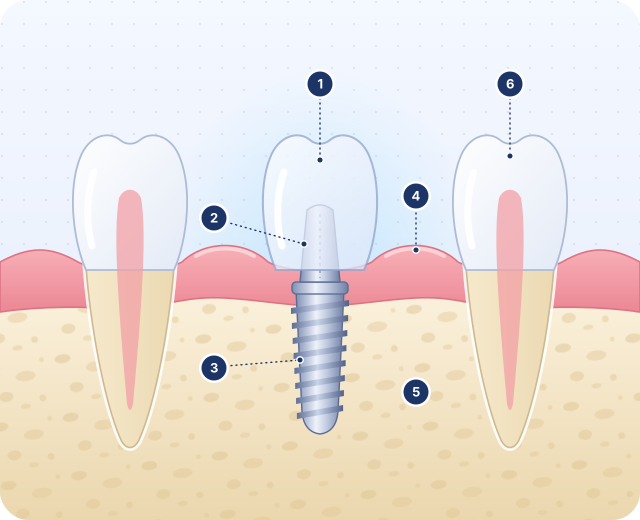
- An implant has three parts: the post in the bone, a connector (abutment) and the crown you see.
- A standard implant takes about 3 to 6 months from placement to final crown, because the bone needs time to heal around it.
- You need healthy gums and enough bone. If bone is lacking, a graft may be advised first.
- Smoking and poorly controlled diabetes raise the risk of an implant failing.
- An implant is not the only option. A bridge or a removable denture may also be suitable.
When is a single implant considered?
An implant may be considered when one tooth is missing or cannot be saved, for example after an injury, a deep fracture, decay or a failed root canal treatment. It can also replace a tooth that never developed.
Implants are placed once the jaws have finished growing, so they are not used in children and younger teenagers.
The alternatives
Your dentist should explain every reasonable option, including doing nothing. Each has advantages and drawbacks.
- A bridge, which is fixed to the teeth beside the gap. It is quicker, but those teeth usually need to be prepared.
- A removable partial denture, which is the simplest option but is taken out for cleaning.
- Leaving the space. This is sometimes reasonable for a back tooth, although neighbouring teeth can drift over time.
Your assessment
Your specialist asks about your general health and medicines, examines your teeth and gums, and takes X-rays. A 3D cone beam CT (CBCT) scan is used where needed to measure the bone and to locate nearby structures such as nerves and the sinus.
Gum disease and decay elsewhere in the mouth are treated first. Digitally guided surgery, using a custom 3D-printed guide, is available where your case calls for it.
The stages of treatment
Treatment is usually done in stages over several months.
- Placement. The implant is placed under local anaesthetic, so the area is numb. Sedation is available for anxious patients.
- Healing. Over the following months the bone grows onto the implant surface. A temporary tooth can often be provided for a front tooth.
- The crown. Once the implant is stable, impressions or a digital scan are taken and a crown is made and fitted.
- Review. The implant is checked and you are shown how to clean around it.
Can it be done faster?
In suitable cases an implant can be placed on the day a tooth is removed, and sometimes a temporary crown can be fitted soon afterwards. This depends on the bone, the gum, your bite and the absence of infection. Where conditions are not right, a staged approach is the safer choice. Your specialist decides this after examining you.
Recovery and looking after an implant
Some swelling, bruising and soreness are normal for a few days after placement. Most people return to normal activities quickly. You will be given written aftercare instructions and advice on what to eat while the area heals.
An implant cannot decay, but the gum and bone around it can become inflamed if plaque is allowed to build up. Brush twice a day, clean between the teeth, and attend regular check-ups. If you grind your teeth, a night guard may be advised.
Possible risks
Implant treatment has a long record of use, but no treatment is free of risk. Your specialist will explain the risks in your own case.
- Infection or slow healing after surgery
- The implant failing to bond with the bone, in which case it is removed and the options are reviewed
- Injury to nearby structures such as a nerve, the sinus or a neighbouring tooth, which careful imaging and planning aim to avoid
- Inflammation and bone loss around the implant in later years (peri-implantitis), more likely with poor cleaning, smoking or a history of gum disease
- Chipping of the crown or loosening of the screw, which can usually be repaired
- Gum shrinkage that affects appearance, mainly at the front of the mouth
Why have an implant at FaceLab
Implants at FaceLab are planned and placed by specialists, with restorative specialists involved in the crown. Imaging, surgery and the final tooth are provided in one clinic at The Shoppes at City of Dreams, Colombo. The implant systems offered include Dentium, JD and Nobel Biocare, and your specialist recommends one after assessing you.
FaceLab implant packages carry a warranty, with conditions that include good oral hygiene and annual check-ups. The terms are set out on the treatment packages page.
Single tooth implant: common questions
The area is numbed with local anaesthetic, so you should feel pressure rather than pain. Sedation is available for anxious patients. Afterwards there is usually some soreness for a few days, managed with pain relief.
A standard implant takes about 3 to 6 months from placement to the final crown. It takes longer if a bone graft is needed first. In suitable cases a temporary tooth can be fitted earlier.
With good cleaning and regular check-ups an implant can last for many years, but no one can promise that it will last for life. The crown on top may need repair or replacement in time.
There is no upper age limit. Suitability depends on your general health and on the bone and gums, which are assessed at your consultation.
Smoking raises the risk of infection and of the implant failing. Your specialist will discuss this with you and will advise you to stop, at least around the time of surgery.
Starting prices for a specialist-placed implant with crown are published on our fees page. The fee for your case, including any grafting, is confirmed in writing after your assessment.
Consultant-led care, with 3D imaging available
Talk to our team about your case
Related
General information, not a diagnosis. Your consultant will advise on your own treatment. Last reviewed 2026-11-16.