

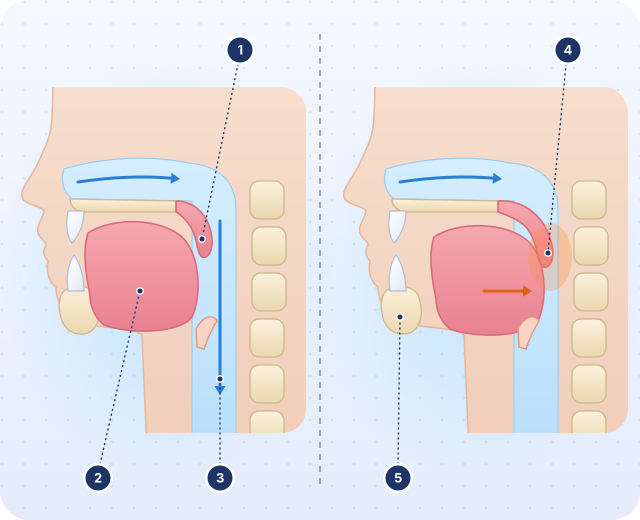
At a glance
- Common signs are loud snoring, pauses in breathing noticed by others, and daytime sleepiness.
- Sleep apnoea is diagnosed with a sleep study, which can often be done at home.
- Untreated sleep apnoea is linked to high blood pressure, heart disease and accidents caused by sleepiness.
- CPAP is the main treatment for moderate and severe sleep apnoea. Oral appliances suit some patients.
- Treatment is long term and needs follow-up.
Symptoms of sleep apnoea
Many people with sleep apnoea do not know they have it. A bed partner is often the first to notice. Symptoms develop slowly and are easy to put down to a busy life or to getting older.
- Loud snoring on most nights
- Pauses in breathing, gasping or choking during sleep
- Waking unrefreshed, with a dry mouth or a headache
- Sleepiness during the day, including while driving or working
- Poor concentration, irritability or low mood
- Waking at night to pass urine
Why treatment matters
Untreated obstructive sleep apnoea is associated with high blood pressure, heart disease, stroke and type 2 diabetes. Sleepiness also raises the risk of accidents on the road and at work.
If you feel sleepy while driving, you should not drive until you have been assessed and treated. Your doctor will advise you on this.
Who is more likely to have it?
Sleep apnoea can affect anyone, including people of normal weight. It is more common with the following.
- Excess weight and a larger neck size
- A small or set-back lower jaw, large tonsils or a narrow airway
- Increasing age
- Alcohol, sedatives and smoking
- A family history of sleep apnoea
Diagnosis: the sleep study
After a consultation and examination, a sleep study records what happens while you sleep. A home study uses a small recorder that measures breathing, oxygen level and heart rate in your own bed. A more detailed study, with additional sensors, may be advised for some patients. Home-based and in-clinic studies can be arranged.
The study counts how many times an hour your breathing pauses or becomes shallow. Doctors use this number, together with your symptoms and general health, to grade sleep apnoea as mild, moderate or severe and to recommend treatment.
Treatment options
Treatment is chosen according to severity, your anatomy, your other health conditions and what you can use comfortably every night.
- CPAP (continuous positive airway pressure). A small machine delivers air through a mask to hold the airway open. It is the main treatment for moderate and severe sleep apnoea.
- Oral appliance therapy. A custom-fitted device holds the lower jaw forward during sleep. It is an option for mild to moderate sleep apnoea and for some people who cannot use CPAP.
- Weight loss and lifestyle measures, which help at every level of severity.
- Positional therapy, for people whose apnoea occurs mainly when lying on the back.
- Surgery, in carefully selected patients, to correct a specific anatomical cause. This can include operations on the jaws.
Living with treatment
CPAP and oral appliances work only on the nights they are used. The first weeks are a period of adjustment: masks may need to be changed and settings adjusted. Follow-up checks that the treatment is controlling the apnoea and that you can live with it. Tell your team early if you are struggling, because most problems can be improved.
Possible risks and side effects
Each treatment has drawbacks, which your doctor will explain.
- CPAP can cause a dry or blocked nose, a dry mouth, skin marks from the mask, air leaks and bloating
- Oral appliances can cause sore teeth or jaw joints and, over years, changes in the way the teeth meet
- An oral appliance may not control more severe sleep apnoea, so a follow-up sleep study may be advised
- Surgery carries the risks of an operation and of anaesthesia, and does not help everyone
Why have sleep apnoea treated at FaceLab
The sleep medicine service is led by consultant respiratory physicians. FaceLab offers diagnosis, CPAP set-up and follow-up, and oral appliance therapy, and the physicians work with orthodontists and maxillofacial surgeons in the same clinic when the shape of the jaws or airway is part of the problem. The clinic is at The Shoppes at City of Dreams, Colombo.
Sleep apnoea treatment: common questions
Snoring is the sound of a narrowed airway. In sleep apnoea the airway repeatedly closes or nearly closes, so breathing pauses and sleep is disturbed. Many people with sleep apnoea snore, but not everyone who snores has sleep apnoea.
Often, yes. Home studies are suitable for many adults. Your doctor will advise whether a home-based or in-clinic study is appropriate for you.
Sleep apnoea is usually a long-term condition, so treatment is usually long term too. Some people need less treatment after substantial weight loss or after a successful operation. Do not stop treatment without discussing it with your doctor.
CPAP is generally more effective at controlling breathing pauses, particularly in severe sleep apnoea. An oral appliance can be a good option in mild to moderate cases and for people who cannot use CPAP. Your doctor will advise which is suitable.
Treatment controls it well for most people while it is being used. Weight loss can reduce or sometimes resolve it. Surgery can help selected patients. Your doctor will tell you what is realistic in your case.
Consultant-led care, with 3D imaging available
Talk to our team about your case
General information, not a diagnosis. Your consultant will advise on your own treatment. Last reviewed 2026-11-16.