

At a glance
- Snoring has many causes, so treatment is chosen to match the cause.
- Snoring with pauses in breathing, gasping or daytime sleepiness should be assessed for sleep apnoea.
- Changes such as losing weight, cutting down alcohol and sleeping on your side help many people.
- A custom-made oral appliance worn at night is an option for some patients.
- No single treatment works for everyone.
Why do people snore?
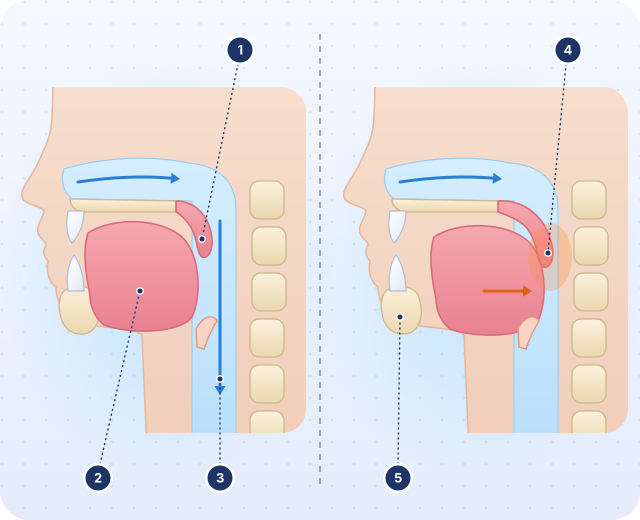
During sleep the muscles that hold the airway open relax. If the airway is narrow, the air moves faster and the soft palate, uvula and tongue base vibrate. Several things make this more likely.
- A blocked nose, from allergy, a bent nasal septum or nasal polyps
- Extra weight, especially around the neck
- Alcohol or sedative medicines in the evening
- Sleeping on your back
- Large tonsils, a long soft palate, or a small or set-back lower jaw
- Smoking, which irritates and swells the lining of the airway
When is snoring more than a nuisance?
In obstructive sleep apnoea the airway does not just narrow but repeatedly closes, so breathing pauses. Simple snoring and sleep apnoea can sound alike. You should ask for an assessment if any of the following apply.
- Someone has noticed that you stop breathing, gasp or choke in your sleep
- You wake unrefreshed or feel sleepy during the day
- You have morning headaches or poor concentration
- You have high blood pressure that is hard to control
Your assessment
The doctor asks about your sleep, your daytime alertness, your general health and medicines, and what a bed partner has noticed. The nose, throat, jaw and neck are examined, and your weight and blood pressure are checked.
If sleep apnoea is suspected, a sleep study is advised. This records your breathing and oxygen level overnight. Home-based and in-clinic sleep studies can be arranged.
Treatment options
Treatment depends on the cause and on whether sleep apnoea is present. Often more than one measure is needed.
- Lifestyle measures. Losing excess weight, avoiding alcohol in the evening, stopping smoking and sleeping on your side.
- Treating a blocked nose, for example with treatment for allergy.
- An oral appliance. A custom-fitted device worn over the teeth at night that holds the lower jaw slightly forward to keep the airway open.
- CPAP, if the sleep study shows sleep apnoea that needs it.
- Surgery, in selected patients with a clear anatomical cause. This is considered carefully, because results vary.
Oral appliances for snoring
An oral appliance, also called a mandibular advancement device, is made from impressions or scans of your teeth. It needs enough healthy teeth to hold it. The amount of forward movement is adjusted gradually to find a position that helps and is comfortable.
Appliances help many people with simple snoring and some with mild to moderate sleep apnoea, but they do not work for everyone. Follow-up is needed to check that the appliance is working and that the teeth and jaw joints are comfortable.
Possible risks and limits
The risks depend on the treatment chosen. Your doctor will explain them before you decide.
- Oral appliances can cause sore teeth or jaw joints, extra saliva or a dry mouth, especially at first
- Over years of use an appliance can change the way the teeth meet
- Treating snoring without checking for sleep apnoea can hide a condition that needs treatment
- Surgery for snoring carries the risks of an operation, and snoring can return over time
- Lifestyle measures take time and need to be kept up
Why have snoring assessed at FaceLab
The sleep medicine service at FaceLab is led by consultant respiratory physicians. Because it sits within a facial and dental clinic, the physicians work alongside orthodontists and maxillofacial surgeons, so that oral appliances and, where appropriate, surgical opinions can be arranged in the same place at The Shoppes at City of Dreams, Colombo.
Snoring treatment: common questions
Snoring on its own is usually harmless, although it can disturb the sleep of others. It matters medically when it is a sign of obstructive sleep apnoea, which is why loud, regular snoring with pauses in breathing or daytime sleepiness should be assessed.
Not everyone who snores does. A sleep study is advised when your symptoms or examination suggest sleep apnoea. Your doctor will explain whether a home-based or in-clinic study is suitable.
Some people find them helpful, but devices that are not fitted to your teeth are more likely to be uncomfortable or to come loose. A custom appliance is made for your mouth and adjusted with follow-up. Any device should be used after sleep apnoea has been considered.
For people who carry extra weight it often helps and sometimes stops snoring altogether, but not always, because snoring has other causes too.
Children who snore regularly should be assessed by a doctor, as the causes and treatments differ from those in adults. Please ask us whom your child should see.
Consultant-led care, with 3D imaging available
Talk to our team about your case
General information, not a diagnosis. Your consultant will advise on your own treatment. Last reviewed 2026-11-16.