

At a glance
- Not every wisdom tooth needs to come out. Removal is advised when a tooth causes problems or is likely to.
- An X-ray, and for teeth close to the nerve a 3D (CBCT) scan, helps the surgeon plan safely.
- Most wisdom teeth are removed under local anaesthetic; sedation or general anaesthesia is available for complex cases or anxious patients.
- Swelling and discomfort are normal for a few days and are managed with simple aftercare.
- Treatment is done by a consultant oral and maxillofacial surgeon.
When do wisdom teeth need to be removed?
A wisdom tooth that has come through fully, is easy to clean and is not causing problems can often be left alone and checked at routine visits. Removal is usually recommended when a wisdom tooth causes, or is very likely to cause, problems.
- Repeated infection of the gum around a partly erupted tooth (pericoronitis), with pain, swelling or a bad taste
- Decay in the wisdom tooth or in the back of the tooth next to it, where food gets trapped
- Gum disease or bone loss around the neighbouring molar
- A cyst or other change around an impacted tooth seen on an X-ray
- A tooth that is in the way of other planned treatment, such as orthodontics or jaw surgery
Your assessment
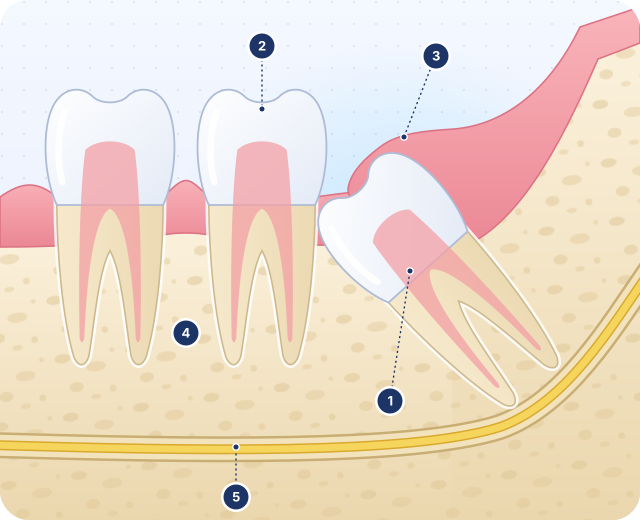
Your surgeon will ask about your symptoms and medical history, examine your mouth and take an X-ray. The X-ray shows the position of the tooth, its roots and how close it lies to the nerve that gives feeling to the lower lip and chin.
If the roots are very close to the nerve, a 3D cone beam CT (CBCT) scan gives a much clearer picture. This helps the surgeon choose the safest approach and explain your individual risks before you decide.
What happens on the day
Most wisdom teeth are removed in the clinic under local anaesthetic, so the area is numb while you stay awake. You may feel pressure but should not feel pain. For several teeth at once, deeply impacted teeth or very anxious patients, sedation or a general anaesthetic can be arranged.
A tooth that has come through may be removed much like any other tooth. An impacted tooth may need a small opening in the gum, and sometimes the tooth is divided into pieces so it can be removed with less disturbance to the bone. Dissolving stitches are often placed. The procedure time depends on how the tooth is positioned; your surgeon will give you an idea beforehand.
Recovery and aftercare
Some swelling, stiffness and discomfort are normal and usually peak in the first two to three days before settling. Most people return to work or study within a few days, depending on the type of removal and the job they do.
Your team will give you written aftercare instructions. Typical advice includes:
- Bite gently on gauze for the first hour and avoid rinsing hard on the first day so the blood clot can settle
- Use cold packs on the cheek on the first day to help with swelling
- Take pain relief as advised, and any other medicines your surgeon prescribes
- Eat soft foods and avoid very hot drinks, alcohol and smoking while the area heals
- From the next day, rinse gently with warm salt water after meals and keep brushing the rest of your teeth
- Contact the clinic if pain gets worse after a few days, if bleeding does not stop, or if you have fever or increasing swelling
Possible risks
Wisdom tooth removal is a common procedure, but like any surgery it has risks. These include bleeding, infection and dry socket (when the clot is lost and the socket becomes painful a few days later). Lower wisdom teeth close to the nerve carry a risk of numbness or tingling of the lip, chin or tongue; this is usually temporary but can occasionally be long-lasting. Your surgeon will explain the risks that apply to your teeth, which is why careful imaging and planning matter.
Why have it done at FaceLab
Wisdom teeth are removed by consultant oral and maxillofacial surgeons, who also treat complex cases such as teeth near the nerve and impacted teeth. Imaging and planning, the procedure and follow-up all happen in one place at The Shoppes at City of Dreams, Colombo.
Wisdom teeth removal: common questions
The area is numbed, so you should not feel pain during the procedure, only pressure. Afterwards there is usually some soreness and swelling for a few days, which is managed with pain relief and aftercare.
Not always. A healthy wisdom tooth that can be cleaned is often left alone. Your surgeon may advise removal if an X-ray shows it is damaging the neighbouring tooth, likely to cause infection, or in the way of other treatment.
Often yes, especially under sedation or general anaesthesia. Your surgeon will discuss whether removing them together or in stages suits you better.
Once the numbness wears off you can have soft, lukewarm food. Avoid chewing on the treated side and avoid hot drinks, alcohol and smoking while it heals.
Consultant-led care, with 3D imaging available
Talk to our team about your case
General information, not a diagnosis. Your consultant will advise on your own treatment. Last reviewed 2026-11-09.